

In the industrial world, the transport of bulk materials is an essential element of many production processes. It often happens that these materials must be moved to different heights, including along inclines. In such cases, it is crucial to use appropriate conveyors that ensure the efficient and safe movement of the load. In this article, we will take a closer look at this issue.
Belt Conveyors
Belt conveyors are among the most popular solutions for transporting bulk materials. Thanks to their simplicity and flexibility, they perform excellently in a variety of operating conditions. Belts can be made from various materials, such as rubber or plastics, and their width and length can be adjusted to meet individual needs.
When transporting on inclines, an important issue is ensuring proper belt tension and stabilization. For this purpose, special tensioning rollers are used, which keep the belt at the correct height and ensure its uniform tension. Additionally, to protect the material from sliding off, side guides or special partitions on the belt can be used.
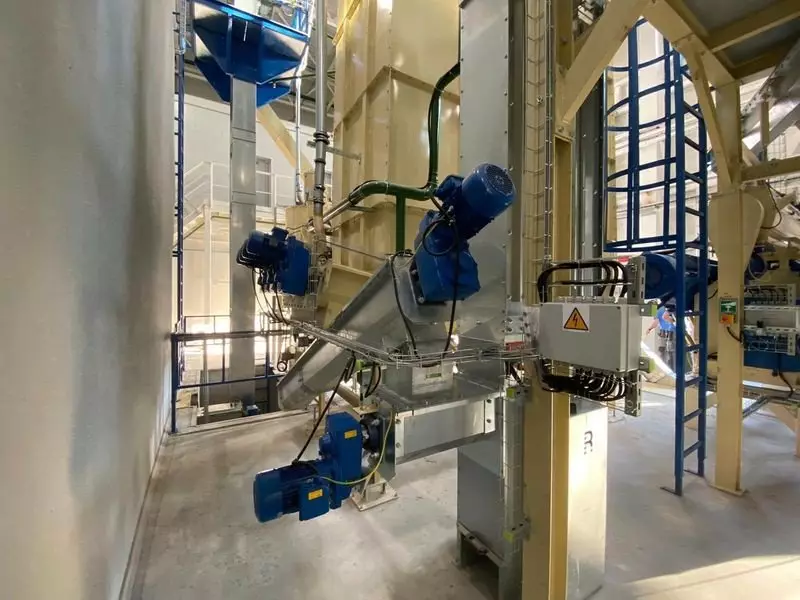
Screw Conveyors
Another solution that works well for transporting bulk materials on inclines is screw conveyors. Their design is based on a spiral element which, by rotating inside a closed tube or channel, moves the material along the axis of the conveyor. These conveyors are characterized by high efficiency and precision in transport, as well as the ability to adjust the inclination angle, allowing the device to be tailored to specific needs.
Bucket Elevators
Bucket elevators are another solution used for transporting bulk materials on inclines. Their operation is based on the use of a series of interconnected buckets that are moved by a chain or belt. During the conveyor’s movement, these buckets collect material from the lower transport point and then carry it to the upper point, where discharge occurs. Due to their design, these devices are used for vertical material transport.