
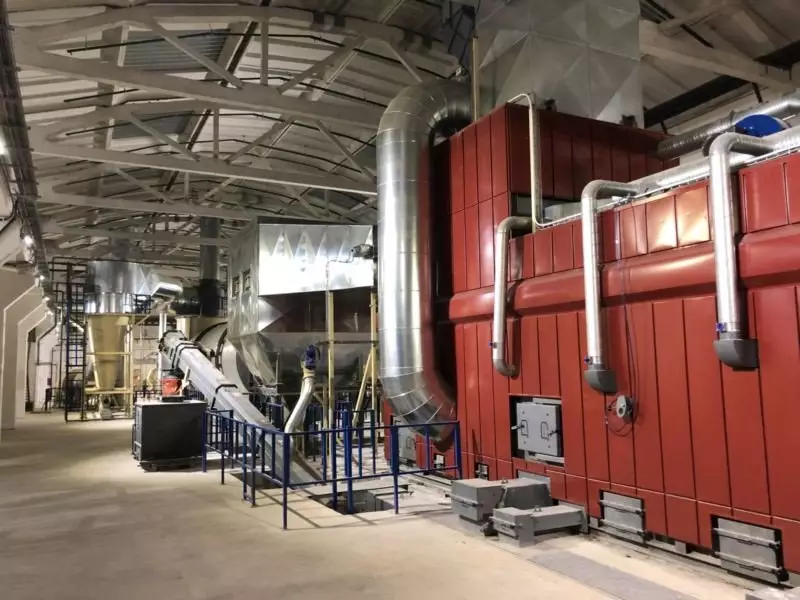
The sawdust drying process is extremely important in many branches of industry, such as the production of wood pellets, briquettes, or particleboard. Drying sawdust allows for achieving the appropriate moisture content of the raw material, which affects the quality of the final product and the energy efficiency of the entire production process. In this article, we will discuss the types of dryers that utilize hot air for drying sawdust.
Drum Dryers
One of the most popular types of dryers utilizing hot air (flue gas) is the drum dryer. In these devices, the drying process takes place within a cylindrical drum that rotates around its own axis. Wet sawdust is introduced at the beginning of the drum, and then—thanks to its special internal design, the rotary motion, and the stream of hot air—the material moves toward the end. The hot air flowing through the dryer drum and the material dries it and transports it to an expansion chamber, where the drying medium is separated from the dry material. Subsequently, the raw material is transported to the further production process, while the drying medium, after passing through a filter, is released into the atmosphere.
Drum dryers are characterized by a short drying time, which translates into high output and efficiency. They are the most economical of all dryer types, as they consume the least thermal and electrical energy per ton of evaporated water. Although they are considered less safe than belt dryers due to the high drying temperature at the drum inlet (approximately 450–500°C), they are entirely safe when modern safety systems are implemented. Drum dryers are also significantly cheaper to purchase than other types of dryers. They can operate both indoors and outdoors.
Belt Dryers
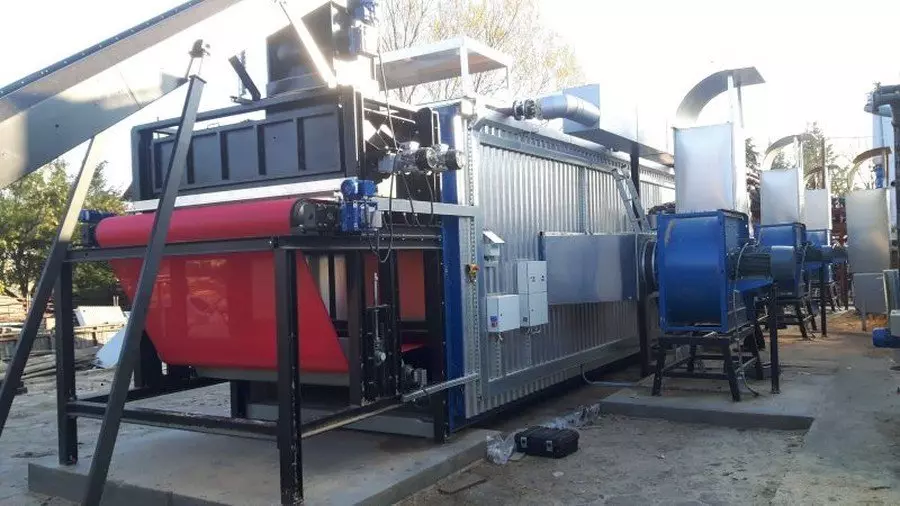
Another type of dryer utilizing hot air is the belt dryer, in which the drying process takes place on a moving belt. Sawdust is evenly distributed across the belt, which moves along the drying chamber. Hot air is sucked into the dryer and flows through the layer of sawdust, absorbing moisture. After passing through the entire length of the drying chamber, the dry sawdust falls into a discharge conveyor that transfers it to the next production stage, while the belt returns via the lower section, where it is cleaned of dust using compressed air and/or a water stream, if necessary.
Belt dryers are considered safer due to the lower drying temperature, which is approximately 85–90°C. They are an ideal solution for materials that cannot be subjected to higher temperatures. However, belt dryers are more expensive to purchase and less economical than drum dryers. They consume about 20% more thermal energy to evaporate one ton of water.
A positive feature of belt dryers is that lower drying temperatures have less impact on the structural changes of the dried material, which can translate into higher quality of the final product. Nevertheless, our 20 years of experience in the industry shows that this does not have a significant impact on the quality of wood biomass pellets.