
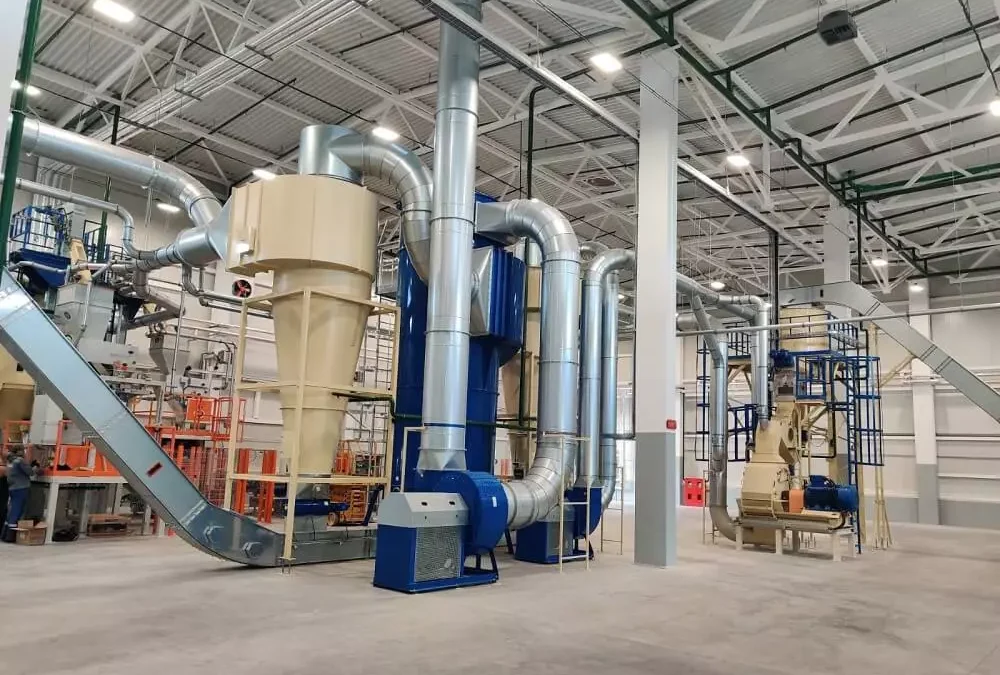
Pellet is a modern heating fuel produced by compressing wood waste—most commonly sawdust from sawmills, carpentry workshops, and woodworking plants—under extremely high pressure. The finished product is distributed as small, densely packed granules in convenient bags, making it an exceptionally user-friendly fuel for both domestic stoves and residential fireplaces. It is also important to highlight that this fuel offers outstanding calorific value while remaining highly eco-friendly; post-combustion, it leaves behind minimal ash and, unlike traditional heating fuels, emits only a negligible amount of harmful gases.
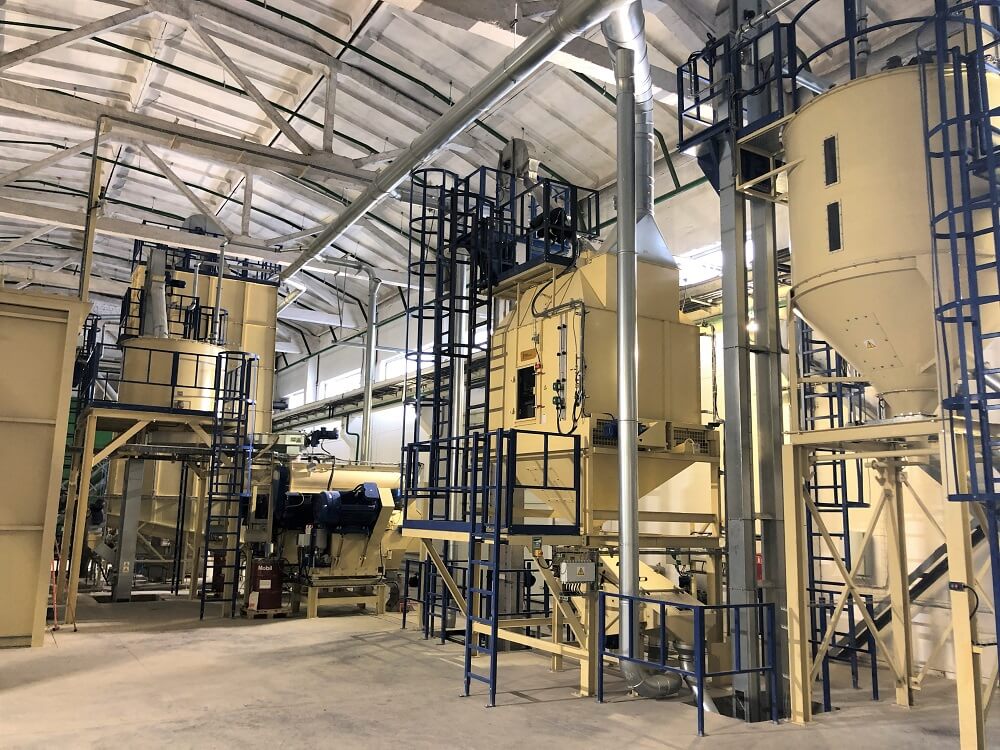
Components of a Pellet Production Line
Pellet production is typically a fully automated process operating within closed-loop production lines. Below is an overview of the core components of these lines and the individual stages of the manufacturing process:
- Initial raw material shredding to achieve a fine fraction that is significantly easier to process further, including drying to the required input moisture level. High-capacity industrial chippers are predominantly utilized for this preliminary size reduction.
- Raw material purification to remove various contaminants such as stones, gravel, soil, or metal fragments. This is effectively achieved using advanced magnetic and pneumatic separators.
- Fraction homogenization utilizing hammer mills, which ensures the preliminary raw material reaches an optimal, uniform size before entering the drying phase.
- Raw material drying involves conveying the material into a drying system where the thermal processing occurs. This fully automated stage continues precisely until the material reaches a strictly controlled moisture content of no more than 8–10%.
- Once properly dried, the wood residues pass through secondary separators and are fed into another hammer mill, which grinds them into a perfectly homogeneous fraction.
- The highly refined material is then transported to the granulation preparation unit, where its moisture levels are carefully stabilized and essential binding agents are precisely dosed.
- Pelletizing (granulation) represents one of the final production stages. The prepared biomass is subjected to extreme pressure and extruded through a specialized die within the pellet press. The resulting hot pellets are subsequently cooled in a pellet cooler and screened to remove excess dust and loose particles.
- Automated packaging of the finished product, efficiently bagging the premium pellets into 10 to 50 kg sacks or standard bulk BIG-BAGs.
The finished product is devoid of any impurities that could have a negative impact on its combustion. In the production process, it was properly compacted and hardened, which positively affects its efficiency. Producing pellet in automatic pellet production lines has many advantages, including primarily allowing to obtain a heating material of very high quality and calorific value.