
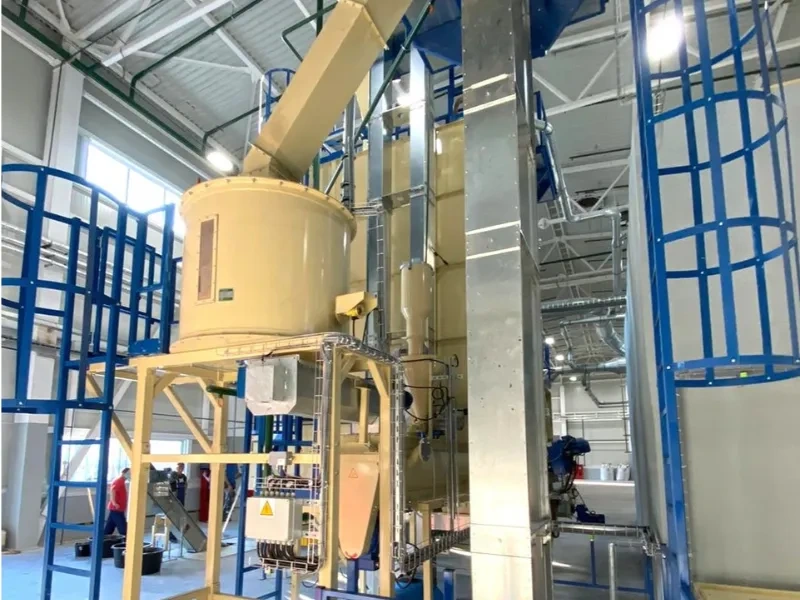
Buffer tanks are part of pellet production lines. Although they are not involved in the direct production of this valuable biofuel, their role is extremely important for optimizing the entire process. What types of tanks are used in pellet technological lines? How do they work? Read the following article.
Professional, industrial pellet production lines consist of many sections. The number, type, and parameters of individual devices included in a given section should be adapted to the specifics of a particular technological line, and above all its efficiency, so as to ensure high work effectiveness and good quality of the final product. Undoubtedly, essential machines in the pellet production process are, for example, the granulator or the pellet cooler; other devices and machines can, but do not always have to be used in technological lines, including, for example, a debarker, packer, pallet wrapper, etc. Buffer tanks are installed before most devices along with a dispenser and feeders to provide temporary storage and proper dosing of the raw material.
How does a buffer tank work?
Manufacturers of buffer tanks offer various models of devices. When choosing them, individual conditions should be taken into account. The most common tanks on the market have a capacity of 2 m³ or 4 m³ and feature two inspection windows, which allow for checking the level of the raw material inside. They can be equipped with one or two dosing conveyors. The material inside is slowly and continuously mixed. Conveyors transport the raw material to the upper part of the tank, from where its excess falls to the bottom. Thanks to this process, the material is not only properly utilized and delivered in the right quantity to subsequent devices, but also, after passing through the buffer tank, the raw material achieves the appropriate form of a homogeneous mixture with a constant density.