
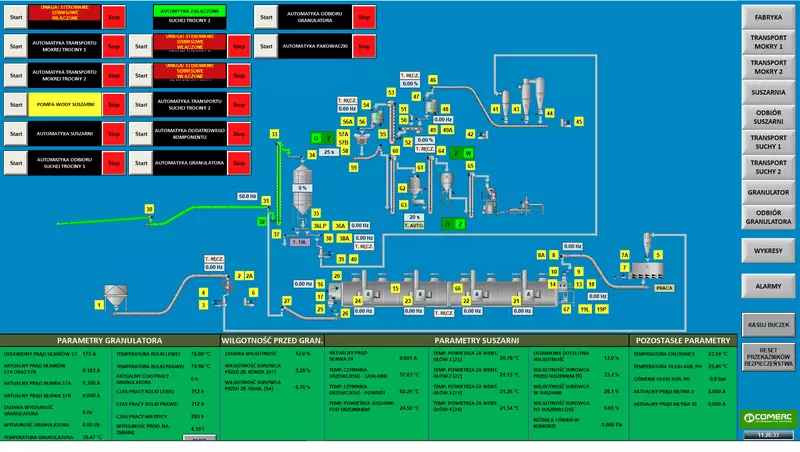
Production automation is currently practically the norm in large manufacturing plants, both foreign and those located in our domestic market. It is one of the most dynamically developing industries. It offers a range of solutions, from the simplest ones that allow moving away from the predominance of the human factor in production, to those offering complete automation and computerization of processes, and thus the complete elimination of human participation in the production process, bringing to mind images from film productions that just a few or a dozen years ago we perceived as science fiction. Why does investing in production automation pay off even for smaller entrepreneurs? We will discuss this in today’s post. Enjoy the read!
Improving production lines
Smaller, private entrepreneurs, who for years have traditionally relied on manual labor, are also increasingly convinced to automate their industrial plants. Today, they see production automation as their chance to maintain their position or establish a presence on the market. This is because automating production makes it possible to understand the finest details of the production process, as well as to collect and analyze information about both the process itself and the conditions under which it takes place (e.g., the speed at which individual components move, the prevailing pressure, the vibrations emitted, or the ambient humidity and temperature). Collecting historical data and conducting analyses enables, among other things: eliminating potential hazards, resolving existing problems and errors more efficiently and effectively, planning the purchase of spare parts and maintenance work, but also—and perhaps above all—continuously improving both the process itself and the final product.

Increased production efficiency.
Industrial automation also has a major impact on production efficiency and quality. Machines, unlike humans, do not need rest, do not get sick, do not take vacations, and can basically work 24 hours a day. This allows the production line to operate much more efficiently and practically without downtime, which, combined with a reduction in the number of staff needed to operate the process, yields tangible savings. Machines have another important advantage: the items they produce are always identical, both in terms of composition and external appearance. Production automation also ensures the maximum utilization of semi-finished products and minimizes the amount of waste. Process monitoring also allows for the optimization of the consumption of utilities such as water and electricity.
Quick return on investment
Although production automation is often a considerable expense for a company, its owner can be certain that it will quickly pay for itself. In a relatively short time, one can notice an increase in efficiency and identify areas where, thanks to process automation, it has become possible to save financial resources, human labor, or the time dedicated to a specific task.